

Two Cans And A String

A 19th-century tin can, or lovers' telephone
A tin can telephone is a type of acoustic (non-electrical) speech-transmitting device made up of two tin cans, paper cups or similarly shaped items attached to either end of a taut string or wire.
It is a particular case of mechanical telephony, where audio (i.eastward., vibrations in the air) is converted into vibrations along a liquid or solid medium. These vibrations are transmitted through the medium (string) and then converted back to sound.
History [edit]
Earlier the invention of the electromagnetic phone, there were mechanical audio-visual devices for transmitting spoken words and music over a greater distance, faster than the speed of sound in air. The very earliest mechanical telephones were based on transmission through pipes or other physical media, and among the very earliest experiments were those conducted by the British physicist and polymath Robert Hooke from 1664 to 1685.[1] [two] From 1664 to 1665 Hooke experimented with audio transmission through a taut distended wire.[three] An acoustic string telephone is attributed to him equally early as 1667.[4]
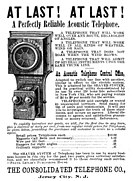
An 1886 ad for an acoustic phone
The highly similar acoustic tin can can phone, or 'lover's phone', has also been known for centuries. Information technology connects 2 diaphragms with a taut string or wire, which transmits audio by mechanical vibrations from 1 to the other along the wire (and not by a modulated electric current). The classic example is the children's toy made by connecting the bottoms of ii paper cups, metallic cans, or plastic bottles with tautly held string.[ane] [v]
For a short period, audio-visual telephones were marketed commercially as niche competitors to the electrical telephone, as they did not autumn within the telescopic of its patent protection. When Alexander Graham Bell'due south telephone patent expired and dozens of new telephone companies flooded the marketplace, acoustic telephone manufacturers could not compete and apace went out of business. Their maximum range was very limited, but hundreds of technical innovations (resulting in about 300 patents) increased their range to approximately 0.v miles (800 m), or more than under ideal conditions.[v] An example of one such company was Lemuel Mellett's 'Pulsion Phone Supply Company' of Massachusetts, which designed its version in 1888 and deployed information technology on railroad rights-of-way, purportedly with a range of three miles (iv.8 km).[two] [6]
In the centuries before tin can cans and paper cups became commonplace, other cups were used and the devices were sometimes called "lovers' telephones". During the 20th century, they came into common utilize in preschools and simple schools to teach children nearly sound vibration.
Performance [edit]
When the string is pulled taut and someone speaks into one of the cans, its lesser acts as a diaphragm, converting the sound waves into longitudinal mechanical vibrations which vary the tension of the string. These variations in tension set up longitudinal waves in the string which travel to the 2nd tin can, causing its bottom to vibrate in a like manner equally the commencement can, thus recreating the audio, which is heard by the second person.
The signal can be directed around corners with at to the lowest degree 2 methods: The showtime is to create a loop in the string which is then twisted and anchored to another object.[7] The 2d uses an actress can positioned on the apex of the corner; the cord is threaded through the base of the can to avoid coming into contact with the object effectually which the signal is to exist directed.[viii]
See also [edit]
- History of the telephone
- Audio-powered telephone
- Speaking tube
References [edit]
- ^ a b McVeigh, Daniel P. An Early History of the Telephone: 1664–1866: Robert Hooke's Acoustic Experiments and Acoustic Inventions Archived 2013-06-xviii at the Wayback Machine, Columbia Academy website. Retrieved Jan xv, 2013. This work in turn cites:
- Richard Waller and edited by R.T. Gunther. "The Postthumous Works of Robert Hooke, G.D., South.R.Southward. 1705. Reprinted in R.T. Gunther's "Early Science In Oxford", Vol. six, p. 185, 25
- ^ a b Grigonis, Richard. A Telephone in 1665?, TMCNet Technews website, December 29, 2008.
- ^ Preface to Micrographia (1665) «I have, past the assist of a distended wire, propagated the sound to a very considerable distance in an instant». Micrographia - Extracts From The Preface
- ^ Giles, Arthur (editor). County Directory of Scotland (for 1901-1904): Twelfth Result: Phone (Scottish Post Function Directories), Edinburgh: R. Grant & Son, 1902, p. 28.
- ^ a b Jacobs, Bill. Acoustic Telephones, TelefoonMuseum.com website. Retrieved January 15, 2013. This commodity in turn cites:
- Kolger, Jon. "Mechanical or Cord Telephones", ATCA Newsletter, June 1986; and
- "Lancaster, Pennsylvania Agricultural Almanac for the Twelvemonth 1879: How to Construct a Farmer's Phone", John Bater'due south Sons.; and
- "Telephone Experiences of Harry J. Scroll as told past him to Due east. T. Mahood, During the summer of 1933 at Kansas City, Missouri: First Telephone Experience."
- ^ "The Pulsion Telephone", New Zealand: Hawke's Bay Herald, Vol. XXV, Iss. 8583, January 30, 1890, p. three.
- ^ Benson, Robert (12 March 2018) [Created in 2014]. "How do you get tin can phones to go around corners?". Can Phones and Corners. Google Sites. Retrieved thirteen March 2018.
- ^ NPASS2 String Telephones Archived 2012-10-14 at the Wayback Machine, "Corner Busters" photos taken 7 October 2012.
External links [edit]
- Tin Can Telephone
- How to Brand a Tin Tin Telephone

Two Cans And A String,
Source: https://en.wikipedia.org/wiki/Tin_can_telephone
Posted by: travisthavence.blogspot.com
0 Response to "Two Cans And A String"
Post a Comment