| When a transversal intersects two or more lines in the same plane, a serial of angles are formed. Certain pairs of angles are given specific "names" based upon their locations in relation to the lines. These specific names may be used whether the lines involved are parallel or not parallel. |  | "Names" given to pairs of angles: | • alternate interior angles | | • alternate exterior angles | | • corresponding angles | | • interior angles on the same side of the transversal | | Let's examine these pairs of angles in relation to parallel lines: Alternate Interior Angles:
The word "alternate" means "alternating sides" of the transversal.
This name conspicuously describes the "location" of these angles.
When the lines are parallel,
the measures are equal .
|  | | 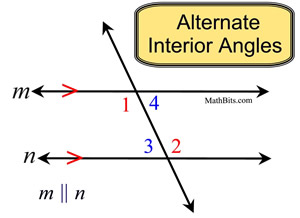
∠ane and ∠2 are alternating interior angles
∠three and ∠iv are alternate interior angles | Alternate interior angles are "interior" (between the parallel lines), and they "alternate" sides of the transversal. Observe that they are not adjacent angles (side by side to one another sharing a vertex). When the lines are parallel,
the alternate interior angles
are equal in mensurate.
g∠ane = g∠2 and m∠iii = m∠4 | |  | If two parallel lines are cutting past a transversal, the alternate interior angles are congruent. | |
Converse | If two lines are cutting by a transversal and the alternate interior angles are congruent, the lines are parallel. |  |  | Alternate Exterior Angles:
The discussion "alternate" ways "alternate sides" of the transversal.
The proper name conspicuously describes the "location" of these angles.
When the lines are parallel,
the measures are equal.
| | 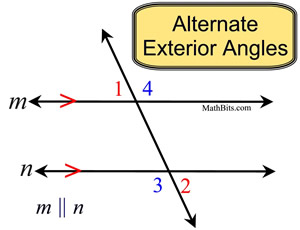
∠1 and ∠2 are alternate exterior angles
∠3 and ∠4 are alternate exterior angles | Alternate exterior angles are "outside" (exterior the parallel lines), and they "alternating" sides of the transversal. Notice that, like the alternate interior angles, these angles are not adjacent. When the lines are parallel,
the alternate exterior angles
are equal in measure.
m∠1 = m∠2 and 1000∠3 = m∠iv | | | If two parallel lines are cut past a transversal, the alternate exterior angles are congruent. | |
Converse | If ii lines are cutting by a transversal and the alternate exterior angles are congruent, the lines are parallel. | Corresponding Angles:
The name does not conspicuously draw the "location" of these angles. The angles are on the Same SIDE of the transversal, one INTERIOR and one EXTERIOR, but not adjacent.
The angles prevarication on the aforementioned side of the transversal in "corresponding" positions.
When the lines are parallel,
the measures are equal .
|  | | 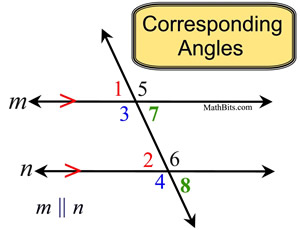
∠one and ∠2 are corresponding angles
∠3 and ∠4 are corresponding angles
∠5 and ∠6 are corresponding angles
∠seven and ∠8 are corresponding angles | If you re-create i of the corresponding angles and you translate information technology along the transversal, it will coincide with the other corresponding angle. For instance, slide ∠ i down the transversal and it volition coincide with ∠2. When the lines are parallel,
the corresponding angles
are equal in measure.
g∠i = k∠2 and yard∠3 = m∠4
k∠five = m∠6 and thou∠7 = m∠8 | | | If two parallel lines are cut by a transversal, the corresponding angles are congruent. | |
Converse | If two lines are cut by a transversal and the corresponding angles are congruent, the lines are parallel. |  | Interior Angles on the Same Side of the Transversal:
The proper name is a description of the "location" of the these angles.
When the lines are parallel,
the measures are supplementary .
| | 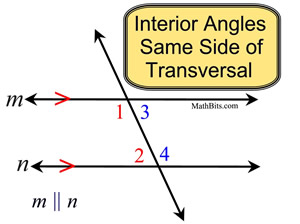
∠1 and ∠2 are interior angles on the same side of transversal
∠3 and ∠4 are interior angles on the same side of transversal | These angles are located exactly as their proper noun describes. They are "interior" (between the parallel lines), and they are on the same side of the transversal. When the lines are parallel,
the interior angles on the aforementioned side of the transversal are supplementary.
m∠1 + chiliad∠2 = 180
m∠3 + k∠4 = 180 | | | If 2 parallel lines are cut by a transversal, the interior angles on the same side of the transversal are supplementary. | |
Converse | If ii lines are cut by a transversal and the interior angles on the same side of the transversal are supplementary, the lines are parallel. | In addition to the 4 pairs of named angles that are used when working with parallel lines (listed above), in that location are likewise some pairs of "old friends" that are also working in parallel lines. Vertical Angles:
When directly lines intersect, vertical angles appear.
Vertical angles are Always equal in measure,
whether the lines are parallel or not.
|  | | 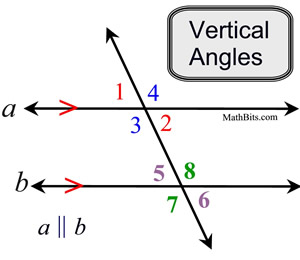 | In that location are 4 sets of vertical angles in this diagram! ∠i and ∠ii
∠3 and ∠4
∠5 and ∠half dozen
∠7 and ∠8 Remember: the lines demand non be parallel to accept vertical angles of equal measure. | | | Vertical angles are congruent. |  | Linear Pair Angles:
A linear pair are 2 adjacent angles forming a straight line.
Angles forming a linear pair are
ALWAYS supplementary .
| | 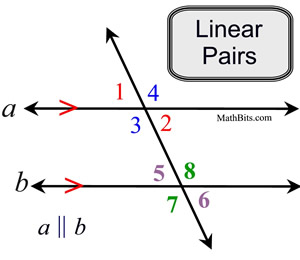 | Since a straight angle contains 180º, the ii angles forming a linear pair also contain 180º when their measures are added (making them supplementary).
m∠1 + g∠four = 180
m∠1 + m∠3 = 180
chiliad∠2 + thousand∠four = 180
thou∠ii + m∠three = 180
thousand∠5 + m∠8 = 180
m∠5 + m∠vii = 180
m∠6 + m∠eight = 180
yard∠half-dozen + grand∠7 = 180 | | | If ii angles form a linear pair, they are supplementary. | 
Note: The re-posting of materials (in function or whole) from this site to the Cyberspace is copyright violation
and is non considered "fair use" for educators. Delight read the "Terms of Utilize". | |

Supplementary Same Side Exterior Angles,
Source: https://mathbitsnotebook.com/Geometry/ParallelPerp/PPangles.html
Posted by: travisthavence.blogspot.com



0 Response to "Supplementary Same Side Exterior Angles"
Post a Comment